
China’s Solar Technology Lock: India Can Build Panels. Can It Master What’s Inside?
A plain-English primer on solar cells, modules and the race from PERC to 907 W tandem panels—followed by the facts behind China’s October 16 export-control draft and the implications for Indian manufacturers and investors.
01 / Start here: cell versus module
A solar cell converts sunlight into electricity. A solar module combines many cells into a protected panel ready to install.
Solar cell
Thin, fragile semiconductor device. Its semiconductor layers, contacts and passivation determine electrical efficiency.
Solar module / panel
Multiple cells wired together and sealed under glass, encapsulant and frame. A 600 W panel is a module, not a cell.
Original schematic illustrations for CapitSignal. Not product photographs or to scale.
The six steps from silicon to electricity
- 01
Polysilicon
Purified silicon feedstock
Bottleneck: Energy, chemistry, purity
- 02
Ingot
A single crystal grown from molten silicon
Bottleneck: Crystal growth & yield
- 03
Wafer
Ultra-thin slices cut from the ingot
Bottleneck: Precision slicing & breakage
- 04
Cell
Wafer processed to produce electricity
Bottleneck: Semiconductor know-how
- 05
Module
Cells protected, wired and laminated
Bottleneck: Assembly & bought-in cells
- 06
Power plant
Modules + inverters + grid connection
Bottleneck: Finance, BOS & grid
Manufacturing sequence is simplified. Polysilicon production involves multiple refining and chemical steps; inverters convert generated DC electricity to grid-compatible AC.
02 / PERC, TOPCon, HJT, back-contact—and tandem
These are solar-cell architectures, not different kinds of power plants. Newer designs can convert a higher fraction of incoming sunlight to electricity, but they also require different machinery, process recipes, technical teams and reliability testing.
| Technology | Illustrative commercial module efficiency* | Why it matters |
|---|---|---|
| PERC | ~20–22% | Mature and established; less competitive at the high-efficiency frontier. |
| TOPCon | ~22–24% | High-efficiency passivated contacts; large commercial manufacturing base. |
| HJT | ~22–24% | Different thin-film contact architecture; process and material trade-offs. |
| Back-contact / BC | ~23–25% | Moves front-side contacts to rear, improving light collection. |
| Perovskite–silicon tandem | 29.2% demonstration[7] | Multiple absorber materials capture different wavelengths; commercial durability and yield remain key hurdles. |
*Broad indicative ranges, not sector-wide measured averages or theoretical ceilings. Exact products differ. The 29.2% tandem figure is a specific verified demonstration, not a typical mass-market product.
- Peak power produced under standard test conditions by Trina Solar’s demonstrated tandem module.
- 907 Wp
- Its verified full-area conversion efficiency, according to Trina Solar (June 2026).[7]
- 29.2%
Rated power = module area × 1,000 W/m² × efficiency. A physically larger module may have more watts without having higher efficiency. For equal area, increasing efficiency from 23% to 29.2% delivers roughly 27% more rated power.
Trina describes a TÜV SÜD-verified demonstration, not proof of mainstream commercial deliveries at 907 W. Source: Trina Solar, June 9, 2026.[7]
Technology evolution increases investment risk: a company spending heavily on one architecture may need upgrades before the investment has earned an adequate return. That is why transfer of production-line know-how, not simply ownership of a machine, matters.
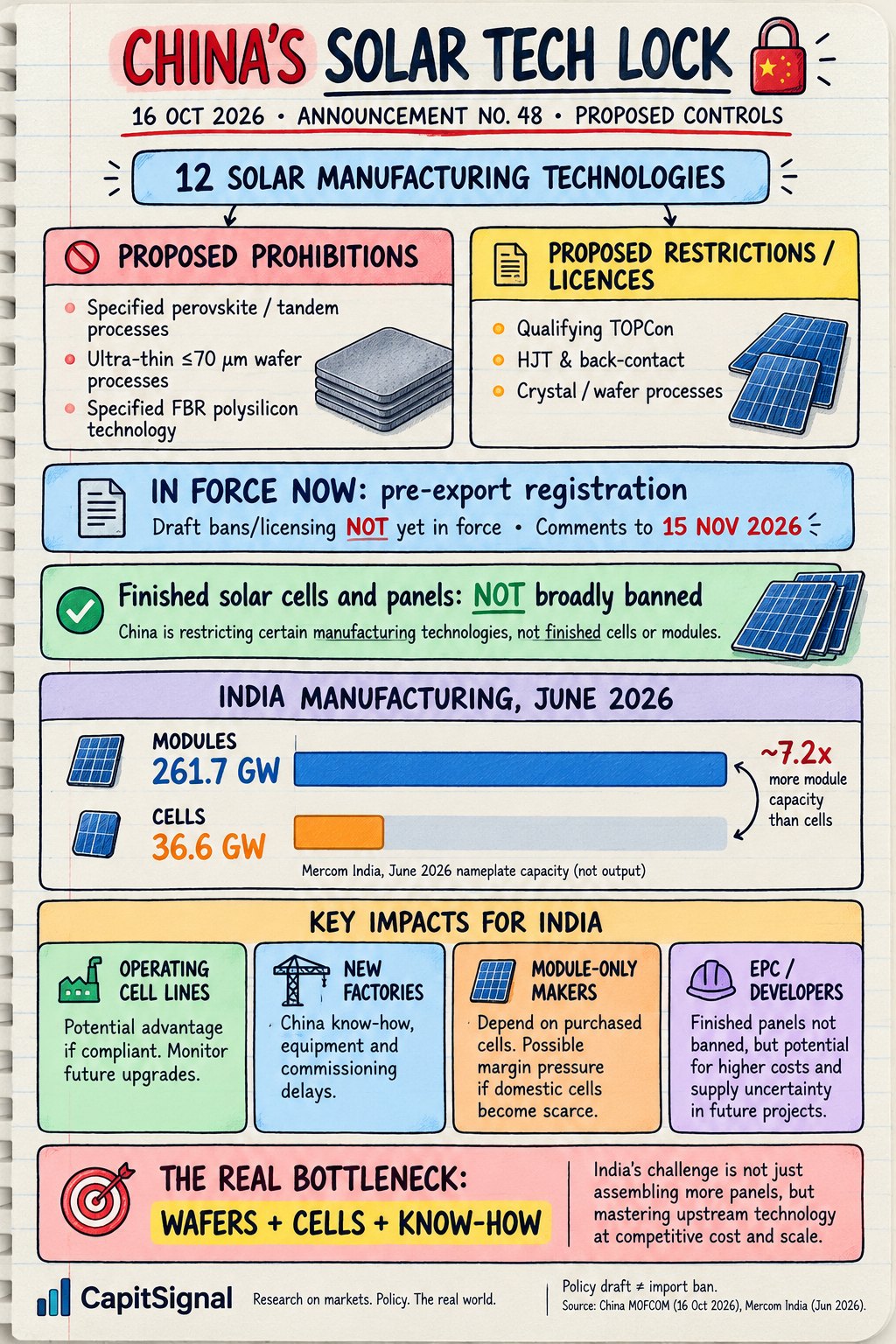
Original CapitSignal graphic. Sources: China MOFCOM (16 Oct 2026)[1], Mercom India (Jun 2026)[4]. Policy draft ≠ import ban. Select to open full size.
Continue with CapitSignal Research
Unlock the complete analysis: 5 more sections.
- 03 / India’s gap: abundant panels, relatively scarce cells
- 04 / China’s October 16 policy: what is proposed, what is active?
- 05 / Indian winners, risks and the investor filter
- 06 / Conclusion
- Methodology
One annual subscription. Every report opens fully, no per-article prompts.
Companies mentioned
- Emmvee
- Premier Energies
- Tata Power
- Vikram Solar
- Waaree Energies
Named for context. Not a rating or recommendation on any company.
CapitSignal provides research and market intelligence for informational and educational purposes. Research scores, scenarios and analysis are not guarantees of future performance.